
Tuscarawas Released Mugshots and Records
A booking photograph records a person's appearance during an agency booking. It does not state release time, destination, court disposition, or present custody. Tuscarawas County publishes photos in its dated PDF for Currently Housed Inmates. When a person leaves that snapshot, the photo can vanish even though the Sheriff's underlying booking record may remain.
Ohio's Public Records Act, ORC 149.43, generally provides access to agency records but contains exemptions for protected, confidential, investigatory, juvenile, victim, and sealed material. There is no researched categorical rule making every adult booking photo secret. Access still depends on the record and any specific exception or redaction. The respectful approach is to request only the identified booking photo needed and confirm the person's status from a separate custody source.
Where Tuscarawas Released Mugshots Appear
Five practical channels are documented, and each has a different scope. None should be treated as a gallery of people currently released. Match name, date of birth, booking, DRC number, or case where the source provides those fields.
| Channel | Photo status | Access and limit |
|---|---|---|
| TCSO current roster PDF | Yes, while listed | Current custody snapshot only, not release history |
| TCSO records request | May provide booking photo | Ask for the named booking, subject to law and retention |
| ODRC Offender Search | Often shows an institutional image | Applies to an Ohio prison record, not proof of a county booking |
| Tuscarawas E-SORN | May show a registry image | Only for people with a legal registration duty |
| Official press or local reporting | Sometimes | Article image may be old and is not a release record |
VINE is useful for release and transfer alerts, but it is not promised as a lasting photo archive. Unofficial aggregators may be stale or wrong. They receive no links or endorsement here. An official image association must still be checked against current status and the original booking.
A person absent from the county PDF may have gone to the community, ODRC, another jail, federal custody, or immigration custody. The image cannot distinguish those paths. Contact TCSO for the release or transfer record, inspect the court disposition, and use the receiving system when a transfer is shown. This is especially important when an older photo continues to circulate after custody has changed.
Tuscarawas Sheriff App Photo Limits
The official Tuscarawas County Sheriff OH iOS app launched in October 2025. Its published description advertises public-safety reporting, tips, news, and mental-health, crisis, and addiction information through local partners. It does not advertise inmate lookup, release lists, or mugshots. Vendor capability elsewhere does not prove Tuscarawas enabled a photo module.
The official App Store listing is the source for those actual feature claims.
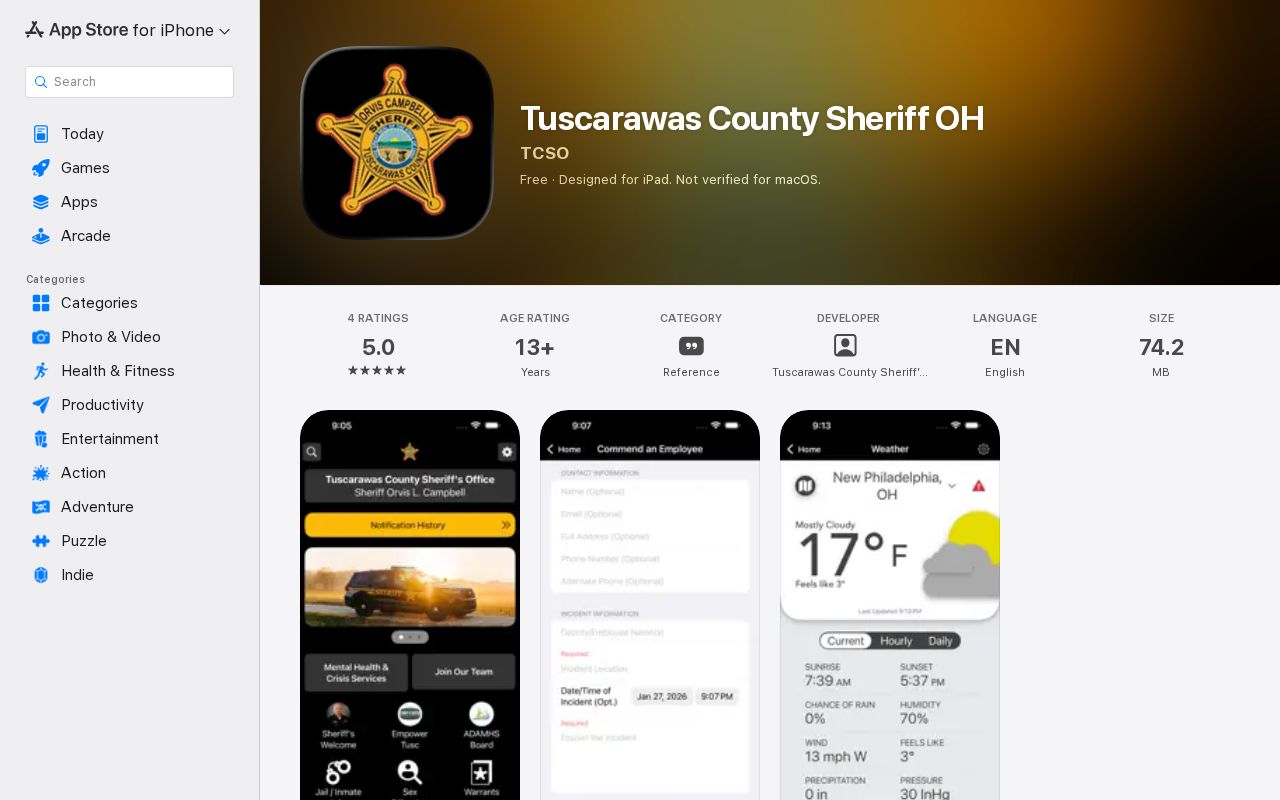
The listing supports use of the app for its stated public-safety functions, but not a claim that it holds released-inmate photos.
The official web roster is also limited. It shows current inmates, booking date and time, hold reasons, sex, height, date of birth, age, and a photograph. It omits release date, reason, destination, case number, booking number, projected date, and supervision. The Tuscarawas 24-Hour Releases explanation details why booking dates cannot be converted into a release feed.
Request Tuscarawas County Booking Photos
TCSO Civil/Records is the durable official route after a photo leaves the current PDF. The posted policy requires enough clarity to identify the record, but no special wording. A requester generally need not write the request, identify themself, or explain its purpose. A narrow name and approximate booking date helps the office locate the correct image.
- Provide the full name and date of birth or another identifier. Add booking date, booking number, or case if known.
- Ask for the booking photograph tied to that specific TCSO booking, plus booking and physical release date if release verification is also needed.
- Choose electronic delivery when practical and ask for cost notice before reproduction.
- Submit through TCSO Civil/Records or call the Sheriff's Office at 330-339-2000 for routing.
- If material is withheld or redacted, ask for the legal basis stated in the response.
Inspection hours are Monday through Friday, 8:00 a.m. to 4:30 p.m., excluding holidays. The policy's goal is acknowledgment or satisfaction within three business days, not a guaranteed completion deadline. It lists the first twenty pages free, later or personal copies at five cents per sheet, email or fax free, and photo or supply costs as specified in the policy. Photo retention follows an approved schedule, but no booking-photo-specific period was found.
The official Records Department page supplies the county request route.

The source helps route a focused booking-photo request after the current roster no longer carries the image.
A focused request can say: “Please provide the booking photograph for the named person and booking, with the booking and physical release date and time if maintained.” Add the approximate date and case number when known. If the person was transferred, ask for the destination custodian. That added field prevents an image request from being mistaken for proof that the person entered the community.
Tuscarawas Press Images Need Verification
Sheriff press posts or reputable local reporting may retain an arrest image after the source roster changes. The publication date shows when the item appeared, not when the person left custody. Captions can also describe a charge that was later dismissed, amended, or resolved. Confirm the booking and disposition through TCSO and the correct court.
Commercial photo mirrors and data brokers are not official. Their images, spellings, charges, and custody labels can remain online after agency records change. No commercial mugshot site is linked, and no paid removal service is endorsed. If a lawful sealing order affects access, ask the originating agency and publisher to apply that official record rather than using an unofficial mirror to reconstruct restricted material.
Verify Tuscarawas Mugshot Identity
A photograph should be tied to the record that created it before any conclusion is drawn. The Tuscarawas roster may display full name, date of birth, age, physical details, booking date and time, holds, and a photo. Those fields help distinguish people, but the PDF still describes its current custody snapshot. It does not supply a release time, destination, case number, booking number, or supervision result.
For a photo requested from TCSO, compare the subject's name and birth information with the booking date and the correct court case. Follow a felony preliminary case from New Philadelphia Municipal Court or Southern District into Common Pleas after bind-over. The docket can show the legal disposition, but it does not authenticate every copy of an image found elsewhere. The Sheriff's booking record remains the source for a county booking photograph.
An ODRC institutional image belongs to a state corrections record. Confirm the DRC number, county, docket, offense, and status before connecting it to a Tuscarawas case. A registry image belongs to E-SORN and applies only to a person with a legal registration duty. A press image may be a file photo from an earlier event. Label each image by its source, and do not describe it as a current Tuscarawas mugshot unless the official record supports that wording.
Photo and release verification are two separate checks. The image can help confirm identity. The jail release record, ODRC status, receiving-custody record, and court disposition establish what happened after custody. If those records conflict, contact the originating agencies instead of selecting the source with the newest-looking picture.
Ohio Sealing Covers Booking Photographs
ORC 2953.31 defines official records broadly. The definition includes photographs, fingerprints, docket notations, papers, files, and indices. Ohio sealing and expungement provisions beginning with ORC 2953.32 can therefore affect photo access. Eligibility, timing, connected charges, and the governing law are case-specific. A vanished image may reflect lawful sealing, an offline record, retention, or a changed roster, not a broken link.
After a court grants relief, use the certified order with the court and agency that maintain the record. Do not claim that sealing means the event never occurred, and do not work around access limits through a commercial copy. Juvenile records follow different confidentiality and sealing rules.
Connected charges can affect the timing and scope of relief under Ohio law. Search the correct court before assuming a photograph should still be public. Common Pleas handles final felony matters; New Philadelphia Municipal Court and Southern District handle their respective lower-court cases. If an image is missing, ask whether the record is sealed, outside the online range, retained offline, or not found.
Southern District states that its online records reach back only to 1994. That archive limit can explain why an older case is missing from a web search even when the clerk retains another access route. It does not prove that the photo was sealed or destroyed. Ask the court and the agency that held the image which rule or retention decision controls.
Ohio Mugshot Payment Restrictions
ORC 2927.22 addresses publishers or disseminators of criminal-record information who solicit or accept payment or other consideration from the subject to remove, correct, modify, or refrain from publishing covered information. The law identifies misuse of criminal record information and provides criminal and civil consequences under its terms.
This is legal context, not removal advice. It explains why pay-to-remove framing is inappropriate and why direct use of official sealing and correction routes matters. The statute should be read in its current form for a specific dispute. Photo discovery remains focused on official access, careful identity matching, and dignity.
A photo correction and a custody correction are also separate tasks. Ask the image-holding agency about the photograph, and ask the releasing custodian about release status. When ODRC supplies the image, label it as an institutional photograph. When E-SORN supplies one, label it as a registry image. Neither source proves that TCSO took the picture, nor does an image reveal where the person is now.