
Tuscarawas Projected and Actual Release
A projected date is a forecast or eligibility marker. An actual release records the event when a named facility gave up physical custody. Those facts can diverge. Credits may change, a court may issue a new order, the Parole Board may act, or another agency may place a hold. A county-jail transfer to ODRC is an actual exit from the jail, but it is not release from custody.
A pretrial detainee has no sentence-based release date. Bond may be posted, charges may be dismissed, or a court may order release, but processing and other holds can delay the physical event. The Tuscarawas roster is a current-custody PDF and does not display a projected or actual release field. A missing name is only a lead to call the jail and review the docket.
Find Tuscarawas County Projected Release Dates
Start with the sentence and custodian, not a date calculator. Tuscarawas County Jail, ODRC, BOP, and ICE are separate systems. A county court sentence should not be entered into an ODRC formula. Likewise, the ODRC expected-date field does not predict a federal or immigration event.
- Identify whether the person is pretrial, serving a county sentence, in ODRC, or held by another sovereign.
- For a county sentence, obtain the sentencing entry and note imposed days, jail-time credit, concurrent or consecutive terms, and later court changes.
- Call Tuscarawas County Jail at 330-339-7783 for its official calculation and ask whether any other hold affects release.
- For an Ohio prisoner, search ODRC Offender Search. Match DRC number, birth data, county, docket, and offense.
- Read status before the exact field Expected Release Date/Parole Eligibility Date. Review sentence, jail-time credit, Board, and supervision fields.
- Confirm changes through the court docket, ODRC or jail, and the receiving agency when a detainer or transfer appears.
The Tuscarawas County release-record workflow explains how to request the physical release time and disposition when a projected date is no longer enough. The court supplies legal authority. The jail or prison record supplies the custody event.
Ohio Earned Credit Is Not 85%
Ohio has no safe universal rule that every person serves 85 percent. Sentence type, offense date, exclusions, mandatory terms, and the governing version of law matter. Some mandatory, homicide, life, and sexual sentences are excluded from credit routes. Reagan Tokes non-life indefinite sentences use a minimum, maximum, and presumptive-release framework under ORC 2967.271. A single percentage would erase those differences.
ORC 2967.193 and OAC 5120-2-06 govern researched earned-credit routes. The statute contains different monthly categories in applicable regimes, an aggregate cap for one route, and a separate completion-credit route with its own limit. The current rule describes productive-participation credit for eligible inmates, exclusions, and loss rules. None supports a general Tuscarawas calculator.
The official earned-credit statute shows why eligibility must be tied to the governing sentence.
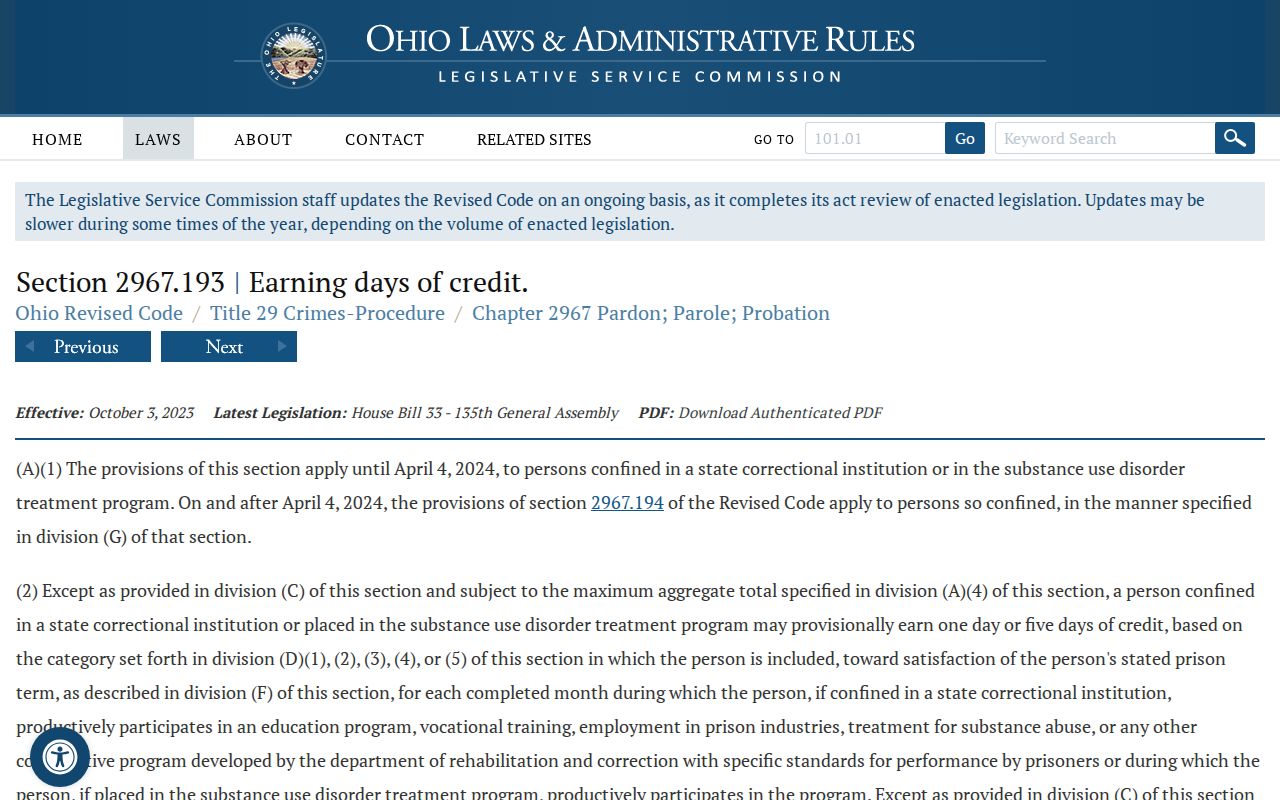
The statutory detail confirms that credit depends on defined routes and exclusions, not a blanket percentage.
Why Tuscarawas Release Dates Change
A valid date can move when the underlying record changes. The effect depends on whether the person is serving a county term, a definite state term, an indefinite term, or a parole-eligible sentence. Do not revise a date from rumor. Find the updated official entry.
| Factor | Possible effect | Confirm through |
|---|---|---|
| Jail-time credit | Changes credited days against the imposed sentence | Sentencing entry and corrections record |
| Earned-credit award or loss | May reduce time or remove a prior reduction | ODRC and governing law |
| Detainer or hold | Can cause transfer instead of community release | Holding facility and requesting agency |
| Court order | May modify, stay, terminate, or judicially release | Filed docket entry |
| Parole Board action | May set, accelerate, continue, or rescind a PRD | ODRC detail and Board minutes |
| Data correction | Can update sentence or status fields | Originating agency |
Tuscarawas ODRC Expected Release Date Fields
ODRC defines Expected Release Date/Parole Eligibility Date as a projected release date or a date pending parole consideration. It is not an actual exit timestamp. The official A814710 example shows why: its status says RELEASED - Judicial Release while the expected-date field remains in the future. Status and the judicial-release order control the custody interpretation.
The official released example places both facts on one record.
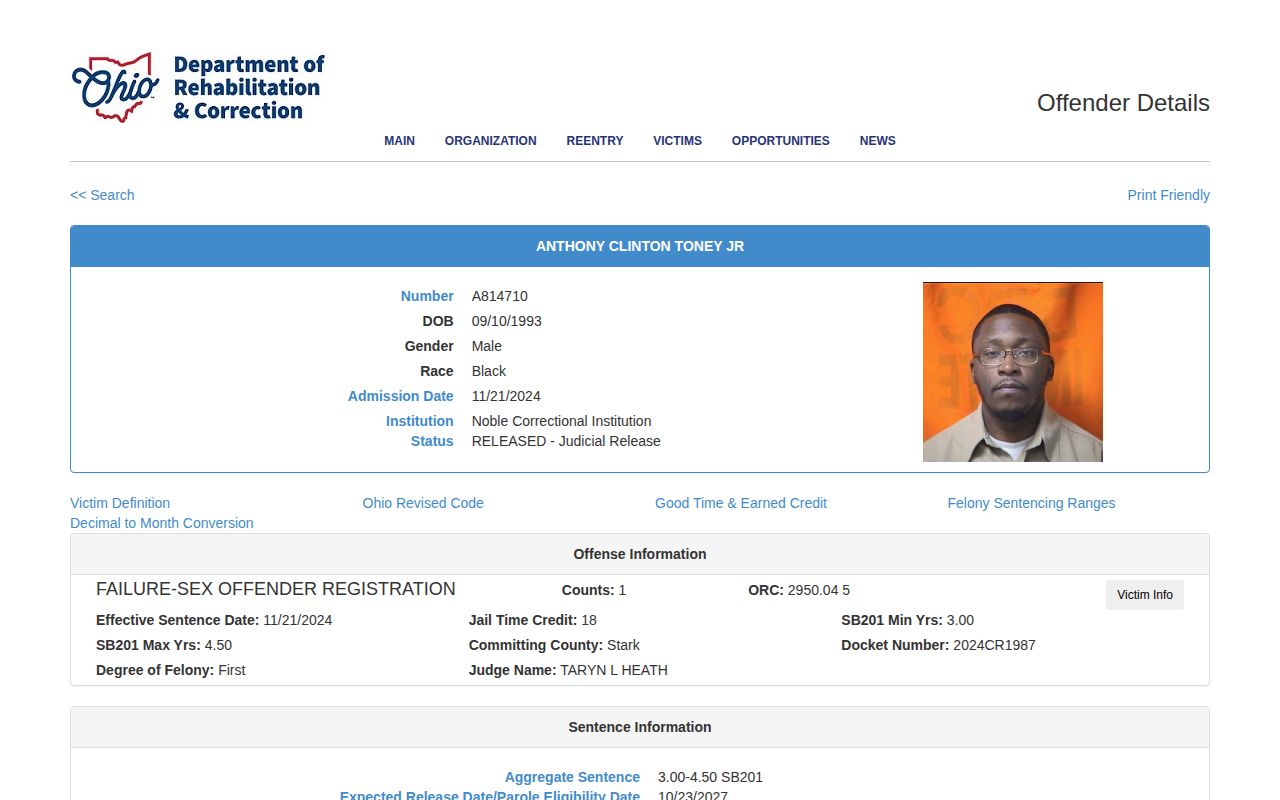
The result proves that a future expected date can remain after prison release and must not be reported as the actual date.
An incarcerated record can show the same field prospectively along with a future supervision start, period, assigned APA office, and Board result. Not every record has every field, and ODRC warns that sentencing data may be incomplete. Last recorded address data is not real-time location data.
Compare the DRC number and birth information before relying on the result. Then review admission, offenses, county, docket, judge, effective sentence date, jail-time credit, and aggregate sentence. A field may relate to another offense, and a later court order may not yet be reflected. If status and date appear to conflict, save the official observation, check the definitions, and contact ODRC or the court. Never overwrite a RELEASED or APA Supervision status with a future expected date. Confirm the final event with the agency that held physical custody.
Tuscarawas Parole Projected Release Decisions
For parole-eligible people, OAC 5120:1-1-10 allows the Board after denial at a regular hearing to set a projected release date or later hearing. A PRD is discretionary. It creates no entitlement and can be accelerated or rescinded. Before the date, the Board may consider institutional conduct, adjustment, programs, and transitional control.
If the public detail shows only shorthand, use official minutes. A continued review is not automatically a grant. ORC 2967.13 contains offense- and sentence-specific parole eligibility, especially for life terms, so there is no universal first-eligibility date. The sentence, offense date, and applicable law control.
Tuscarawas County Jail Date Calculation
No online Tuscarawas county-jail good-time policy or weekend-release rule was found. Do not promise a Friday release when a computed date falls on Sunday, and do not promise a time of day. Start with the filed sentencing entry, imposed days, jail-time credit, concurrent or consecutive terms, and any modification. Then ask the jail for its official date.
For a pending event, the resolved VINE Inmate Check can provide participating release or transfer alerts. An alert is not a certified record. A transfer alert can mean continued custody, and a delayed or missing alert proves neither release nor confinement. Confirm with the jail, court, or ODRC after the event.
Tuscarawas Sentence Types Change Dates
A useful release-date lookup first identifies the kind of legal term. A pretrial Tuscarawas detainee has no sentence-based date because bond, dismissal, a new order, and unresolved holds control the next event. A definite county-jail term starts with the court's imposed days, jail-time credit, and any concurrent or consecutive structure. An Ohio prison term adds the ODRC sentence record and the statutes that applied on the offense date.
Parole-eligible sentences work differently from modern definite terms. Eligibility under ORC 2967.13 does not guarantee release at the first eligible point. The Parole Board can deny release, set a later hearing, or use a projected release date under its rules. Reagan Tokes non-life indefinite sentences use a minimum term, maximum term, and a statutory presumptive-release framework under ORC 2967.271. Judicial release can change actual custody through a sentencing-court order even when an ODRC expected-date field remains in the future.
Credits also need the right category. Jail-time credit accounts for qualifying time already served, while ODRC earned-credit routes depend on statutory eligibility, program participation, exclusions, caps, and possible loss. A detainer can turn an expected community release into a transfer. A new court entry can modify the term. The result is not one formula but a chain: identify the sentence, read the current court and corrections records, account for valid credits or Board action, check every hold, and confirm the event with the custodian.
Do not blend the resulting dates. A jail booking date marks entry, not release. An ODRC parole-eligibility date can mark the point when Board consideration becomes possible, not an ordered exit. A future supervision start can reflect planning while the person remains incarcerated. A BOP date belongs to federal custody. Each label must stay attached to its source and definition, with status checked at the time of the search.
Tuscarawas Court and Jail Reconciliation
A sentencing entry authorizes the term, but it may not show the minute a person walked out. Review the full chronological docket for bond, sentencing, jail-time credit, conveyance, judicial release, modification, and termination entries. One closed case may coexist with another case or hold. If a felony began in a lower court, follow any bind-over into Common Pleas before drawing a conclusion.
The best county confirmation pairs the legal record with the physical record. Ask the jail whether the person was released to the community or transferred to a named custodian. Request booking and physical release date and time, releasing authority, disposition, and destination when transferred. If Common Pleas ordered ODRC conveyance, allow for data transfer and search ODRC. An incarcerated ODRC result then confirms continued state custody, not a community release from Tuscarawas County.
Tuscarawas has three adult docket routes. Common Pleas is the final felony route. New Philadelphia Municipal Court handles its local misdemeanor, traffic, and felony preliminary matters, while Southern District covers its territorial area. A lower-court case may stop at bind-over and leave the final sentence in Common Pleas. Southern District also states that its online history reaches back only to 1994, so an older matter requires clerk contact. These limits can explain a missing online entry without proving release.
Multiple cases matter. A bond release in one docket can coexist with a hold in another. Compare every listed hold reason on the current roster with the available court files. Report the order as an authorized release in that case until the jail confirms the physical exit or transfer. That wording avoids turning a legal step into an unsupported custody event.